Showing posts with label DC. Show all posts

Friday, 15 June 2012

BEFORE WATCHMEN: MINUTEMEN #1


Before Watchmen: Minutemen #1
Writer: Darwyn Cooke
Artist Darwyn Cooke
Pages: 28

Well, the wait is finally over. The greatly publicized prequel to Watchmen is finally on the shelves. Written and drawn by DC heavyweight Darwyn Cooke, Minutemen #1 deals with the early days of super-heroics.
            We start with some slightly heavy handed philosophy for the first two pages which is then humorously thrown aside as the writer goes about the business of introducing the main characters from the point of view of Night-Owl as he narrates them from his book. Everybody gets a fair amount of face-time and the set-ups are nice, though a plot may be difficult to find in it all. The dialogue is crisp and character building and never short of entertaining. This issue is only set-up so time will tell what the actual story is (we only really get glimpses towards the end.
            The art is standard Cooke (in that it jumps off the page) and is much nicer than in The Spirit. The cover is particularly gorgeous and it’s faded, almost sepia look seems quite fitting for the tone of the book.
            To call this project controversial is an understatement. It quite literally divided the comic reading public down the middle. It’s important that a work be taken on it’s own merits. Time will still tell on how Minutemen pans out, but it’s promising o far.

Friday, 28 October 2011

FLASHPOINT

Writer: Geoff Johns
Year: 2011
Publisher: DC Comics
Pages: (176)

The trade for “Flashpoint” came out this week. At 5 issues, it’s a pretty quick read. Now, I have to admit, I’m not a Barry Allen fan. I think he’s a boring character and don’t appreciate that DC sidelined Wally for him. That said, I always have faith in Geoff, so I tore in…
The plot centres around Barry Allen, The Flash. He wakes up one day and realizes that everything is different. There’s no build up or lead in. histories been changed all of a sudden and both Barry and the reader are left scratching their heads and wondering what the hell just happened.
            The first thing I noticed here (with as few spoilers as possible) was the pace. This feels like an episode of a t.v show. There’s only one big action scene and it’s saved for the last two issues. The first three are basically, Barry tries to figure out what’s happened, Barry tries to get his speed back and Barry recruits other superheroes. These are alright on their own, but the book really should have been two or three issues longer, because of the slow pace, by the time we feel things have finally started happening, it’s practically over and we need a quick climax to get out of the way. There’s no big epic moments like in Infinite Crisis. The whole thing is over before the reader knows it. It certainly isn’t helped by the lack of a clear villain. Professor Zoom is only in if for a few pages near the end and the Aquaman/Wonder Woman war serves as little more than a backdrop. And there is a very good reason for this…
            “Flashpoint” is not an event book. This could have been released as issues 13-17 of the Flash ongoing series and nobody would have noticed. This book has the feel of something that was already plotted before DC decided to make it an event and publish 14 tie-in mini-series that barley even matter to the main plot.
            Another problem with this book is the real world relevance. For the big game changer, the book that paved the way for the new 52, this is abysmal. Go read “Booster Gold: Blue and Gold” (also by Johns). It’s the exact same thing, so is “Booster Gold: Day of Death” and probably a lot more after.
            “Flashpoint” does have a few good points going for it. Cyborg was used well and the inclusion of Thomas Wayne as Batman was a stroke of genius. The eventual climax, while brief is quite tragic (though you’d be forgiven for wondering how Barry’s mother not dying caused Clark’s ship to crash in Metropolis instead of Smallville) and the note Thomas leaves for Bruce is quite touching.

The bottom line.
Overall, this book is good as just another Flash story, but as an event book, it’s a joke. The presentation is nice and the art inside is superb.

Next stop.
The new 52 launched in September and are doing pretty well so far. “Animal man” and “Justice League International” are exceptionally good, but there’s really something for everyone.

Thursday, 7 July 2011

THE DEATH AND RETURN OF SUPERMAN

Writer: Various (Mainly Dan Jurgens)
Year: 1992
Publisher: DC Comics
Pages: (784)


The Death of Superman
The year was 1992. DC editorial was looking for something big for Superman. Initially there were plans for him to marry Lois, but that was soon rejected. It was a while later when someone spoke those infamous words, “Let’s just kill him”
            Those four words sparked what has gone down in record as “the best selling graphic novel of all time” of course, if you know your comics, you know that this led into bigger and arguably better stories, being just the tip of the iceberg.
            Anyway, we start off with “The Death of Superman” the first of three volumes, this is a seven issue trade that, funnily enough, contains the smallest amount of storyline. Doomsday breaks free from his restraints underground and goes on a destructive rampage. Eventually, the JLI is called in and fight him, promptly getting their asses kicked. It’s only when Booster Gold (awesome) gets punched into orbit and is saved by Superman that our hero shows up. 
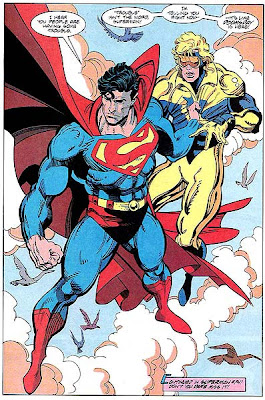
We then get s short series of skirmishes where the JLI is picked off and only Supes remains. I really like the idea that we don’t know what Doomsday looks like as he’s dressed in a green jumpsuit that slowly tears away as the battle progresses. Eventually, the final showdown takes place on the streets of Metropolis, right outside the Daily Planet no less! They have a big sprawling fight and… that’s it. They both drop dead. Well, at least Superman’s inner monologue tells us that he knows he’s not walking away from this one.
            The panel lay-out is very clever with the issues having progressively less panels per page until the last, death issue, which is just a series of big splash pages.


World without a Superman
This trade is a 9 issue book and serves as both a eulogy to the character as well as set-up for the next volume. It has everything from how to dispose of Domsdays’ body to trying to resuscitate Clark to last farewells and the funeral. It is bittersweet and flowing with emotion. The story takes an odd turn however, with the mystery of who stole Superman’s body. We already know it’s Cadmus Labs and the story quickly turns tedious as all the reader is doing is waiting for the other characters to figure this out, but at least the Guardian gets something to do.
Eventually Clarks’ body is returned to his eternal resting place and we finally have a conclusion…until Jonathan Kent falls over and has a vision. He winds up on the astral plain with Clarks’ spirit, who got lost on his way to heaven. He manages to grab onto him, but wakes up alone. It’s several days later that the news channels start broadcasting alleged superman sightings and the tomb is reopened to reveal that the body is gone…again.

Reign of the Supermen (The Return of Superman)
            This trade is a beast. It clocks in at 21 issues ( 480 pages!) The plot deals with the emergence of four individuals who are trying to step into the void left by Supermans’ demise, several of whom claim to be Superman. This book was done as a collaboration between the four ongoing Superman titles at the time and it shows, with each title telling the story of one of the four supermen.
            This book certainly has an epic feel and if it sags a little halfway, the fantastic ending more than makes up for it. Eventually, the real Clark Kent shows up, newly resurrected and Green Lantern and the Matrix Supergirl are also roped in.
            Eventually the status quo is resumed (more or less) and some great new characters are added, such as Superboy (Connor Kent), Steel (john Henry Irons) and Cyborg Superman (Hank Henshaw), who all go on to greater success.

The bottom line.
Like most stories, The Death and Return of Superman has a strong opening, a slow second act and a strong ending. My edition is in the three trades so I can’t comment on the quality of the omnibus collection, though I imagine the spine thickness may be a problem. A minor annoyance is that issue covers are not included in the story, making it a bit difficult to tell when one issue ends and another begins.

Next stop.
Superman: Doomsday omnibus.
A collection of further Doomsday appearances, Hunter/prey, the natural sequel and where the Doomsday character should have been dropped, a very nice doomsday origin issue, the forgettable Doomsday Wars mini and a few Our Worlds at War tie-ins.

Saturday, 18 June 2011

Green Lantern review

Okay. I went to see Green Lantern last night & spent a lot of today thinking about it and mulling it over in my head. As a fan of the franchise, though not specifically a Hal fan (I’m more of a Guy guy) I was initially excited but thrown off by the first trailer. I remained cautiously optimistic and found all the negative reviews very disappointing. However, I had my ticket since Tuesday and was going with a group of friends.
This film had good points and bad points but I have to say, were these reviewers even watching the same film as I? What I mean is, I can see the problems in Green Lantern but from reading various reviews you would think that these problems made the film unwatchable. So here’s my thoughts…
The good.
The effects. The CGI that had been so worrisome from the trailers has been tightened up and looks superb, not Avatar or Tron: Legacy superb but you know what I mean. The computer rendered motion capture suit looks very good but the mask can be a little jarring at first (though you quickly get used to it) The constructs are imaginative and the climax is fantastic. Oa looks nicely rendered, though it’s quite different to the comics. Other lanterns such as Tomar-Re are also very well done and feel real.
The comedy. The film itself isn’t a comedy but it does have some comedic elements. These were all well executed without overloading the film or drifting into slapstick. Likewise, the film makes sure that it doesn’t take itself too seriously.
The bad.
The tone/editing. This film had quite a dramatic shift in tone at times though that can be put down to sub-par editing and directing/screenplay. One notable example is when Hal first recites the oath. This should be a big moment in the film and we thing we’re going to fly to Oa but instead we suddenly find ourselves in a bar scene with Carol. In my opinion, this scene should have been after he got back from Oa. Likewise, Sinestro at one point mentions taking a squad of lanterns and going after Paralax. There is a brief scene showing them leaving Oa with intense music but we suddenly cut back to an Earth scene, then cut back to the lanterns attack.
At one point about half way through we have the beauty shot of Oa. The only problem here is that we have seen it already with the scene of Sinestro confronting the guardians about Paralax.
The only time this works well is the quick cuts between Hal speaking the oath and Hector getting infected by Paralax. This does a good job of showing how this event changed both their lives forever as well as juxtaposing their opposite paths towards good and evil.
The screenplay. The plot of Paralax destroying worlds often takes a back seat for the Hal/Carol relationship. The film suffers for this as we don’t really see how much of a threat Paralax can be until the end. The set-up for Hector Hammond is also explored in length but his final confrontation with Hal is over all too quick for the amount of time put into developing the villain.
The mixed.
The acting. This was quite mixed with Hal, Hector and especially Sinestro doing good jobs with the material given them, especially Mark Strong who wasn’t given near enough screen-time. Tim Robbins didn’t really have anything really meaty to do. Blake Livley put up quite a wooden performance and seems nowhere near the next big thing her agents are desperately claiming her to be.

Overall, this is quite a good film. It’s not great but is far from disappointing. The action was excellent but I wish there had been more of a focus on the cosmic elements of the mythos. Also, more Kilowog! I would rate this film a 7 out of 10. Not as good as Iron Man but much better that Iron Man II. I realize that I may get some flak over this but I would rate Green Lantern as just above Thor. This is not The Dark Knight, nor is it trying to be. But what it is, is a fun summer popcorn film and setup for a potentially fantastic sequel.

Monday, 23 May 2011

MILLENNIUM

Writer: Steve Englehart
Year: 1988
Publisher: D.C. Comics
Pages: 192 (issues 1-8)

Millennium was D.C’s big event comic of 1988 and featured most of the characters and teams who were popular at that time i.e. the JLI, the Outsiders, the Green lantern corps and Infinity inc. It was best known for being the first book to really highlight the manhunters, of Green lantern fame, even if they were alluded to a little bit earlier in other comics, similar to the O.M.A.C’s.
The story itself revolves around two Oans who arrive on earth with the intent of selecting ten humans to teach to depart their power to and who will evolve mankind. At the same time, there is an organisation of androids hell bent on stopping this happening at all costs. They have robotic sleeper agents as well as humans who’ve been brainwashed, keeping a close eye on pretty much all the heroes of the DCU. The only real revelation is when we find out who’s a manhunter (which takes place in the tie-ins). We’re never really given any details why, just that the guardians created them to be their police force before the green lanterns, they malfunctioned & have a grudge against said guardians. What follows is a game of cat and mouse, alliances and betrayals and large battles.
Anybody more accustomed to the modern versions of the manhunters will be a bit taken back by the characterisation they’re given here, all anger and emotion. These villains are reminiscent of the silver age and even referred to as a cult.
The book tends to be quite repetitive, with the entirety of the 2nd issue dedicated to the Oans seeking out the ten individuals and repeating the same few sentences to them! They even use the same panel over and over again. The plot tends to meander and stall at several points and when reading, it was the first book I found to be boring (in parts) in quite a while. The overall plot is only average and the writing and art are nothing to write home about. It seems that early on in the book, the writer decided to impart his own political views on various world powers (never a good sign).
The 2nd biggest problem with this book is that at the end, there’s no payoff. None. The entirety of the last issue is dedicated to these so-called “new guardians” and setting them up for their own short lived series before going off into limbo.
But, by far, the greatest problem of Millennium is the tie-ins. There were many of these, featuring various teams and individuals and the main plot of the book ran across the whole line, none of which are collected here. What’s left is a confusing mess with huge gaps in plot and very difficult to follow. The best way to describe it would be if you had the trade of Watchmen or The Filth and about five issues were taken out at random throughout the book. With this collection not re-coloured and printed on matte paper, there is no excuse for D.C. editorial not to include at least the important ones (Booster Gold, JLI, one or two others)

The bottom line.
Confusing book that reads more like a group of random scenes than a series. The lack of any tie-ins to flesh out the plot really do kill this non-event. No amount of money is worth this half-assed collection

Next stop.
Invasion, probably. A much stronger event that actually has a lasting impact on the DCU that’s still here today.

Tuesday, 10 May 2011

THE FILTH

Writer: Grant Morrison
Year: 2002
Publisher: Vertigo
Pages: 320 (issues 1-13)

Wow. The Filth is a 13 issue mini-series and a prime example of what I can only describe as “Morrison unleashed”. Loaded with metaphors and suberb art, this book will keep swimming around in the head for days after reading, even drowning out stuff read more recently and is most defiantly not for children. Indeed, such is the viciously extreme content of this book that one needs a rather strong constitution going in!
            Without giving too much away, the story revolves around a rather creepy man named Greg Feely, who lives alone with his cat in British suburbia. Feely is approached by a woman and unwillingly recruited into “The Hand” a secret police organisation whose job it is to eradicate everything that differs from the status: Q. You see, Feely is really Ned Slade, a former operative of the Hand and Feely is just an artificial personality he was injected with upon retirement.
            The Hand, (also known as “The Filth” due to what they have to put up with) is the real star of the book. A group that has jurisdiction over every other police force in the world, no conscience and hiding secrets of it’s own. It’s a bizarre world of dolphins with prosthetic limbs, chimpanzee assassins and oceans of milk, where operatives travel in flying dump trucks with huge jaws at their back. The world Morrison creates feels completely real and the book is simply overloaded with ideas.
            The early issues deal with seemingly unconnected cases, such as a killer who is using time as a weapon, aging people to death, but the main story, including the reason Slade is brought back, is that a hand agent called Spartacus Hughes has gone rogue and threatening to bring chaos to the world. However, Slade is having a personality crash and isn’t the super-agent he once was.
            The book darts forward and back between the main characters life as Slade and as Feely back in Britain, allowing the reader to question weather all this is real or in Feely’s head. “The Filth” contains strong violence and extreme sexual and pornographic overtones, especially at the mid-way section. The art by Gary Erskine and Chris Weston is excellent, suitably visualizing Morrison’s’ terrifying world.
            It is interesting to note that while this is Morrison’s first major creator-owned series since the end of “The Invisibles” it takes almost the polar opposite viewpoint, i.e. the Invisibles rebel against authority figures while Slade and the Hand are it’s ultimate representatives.

The bottom line.
The world of the Hand is what we paid to see and characterisation is relatively light, with the exception of Feely/Slade. This book will offend people so if you do end up getting it, just be careful who you introduce to it. The Filth can feel a little disturbing and uncomfortable, but that is probably the idea, although it’s a book that’s quite difficult to put down. The metaphorical nature of the book may not be very self evident so several readings may be necessary and the sexual content could be toned down, but this mind-f&%k is one of Morrison’s most daring works and can stand up to pretty much anything out there.

Next stop.
Hunt down a copy of “The invisibles: vol. 1: Say you want a revolution